When you're at Capacity: How to know what to stop carrying and what to protect

Updated: Oct 12
By LaToya Owens | Awaken with Toya
Some days, “I can handle it” becomes the sentence that keeps us overloaded.
We say yes because we care. We keep going because people depend on us. We hold the plan, the feelings, the reminders, the worries, the money stress, the family tension, the unanswered texts, the health concern, the work deadline, the spiritual questions, and the quiet fear that if we stop carrying it all, something will fall apart.
Then one ordinary thing happens, and we snap.
The dishwasher is loaded wrong. A child asks the same question for the fifth time. A friend wants “just a quick call.” Someone sends a message that needs no urgent reply, yet it feels like one more brick in the bag.
That is often what being at capacity feels like. It is not always dramatic. It can look like functioning on the outside while running on fumes inside.

What being at capacity really means
Capacity is the amount we can carry, process, give, feel, decide, and recover from without losing our sense of steadiness.
It is not just about time. A calendar can have open space while a person has no room left. Capacity includes the visible and invisible parts of life.
Someone might have two free hours on a Saturday and still not have the capacity for a hard conversation. Another person might love their family deeply and still not have the capacity to host everyone this weekend. Someone might care about a cause, a friend, or a ministry, and still need to step back for a season.
Being at capacity means your inner resources are already spoken for.
Different parts of us have different limits. You may have physical energy but no emotional bandwidth. You may be mentally sharp but socially drained. You may be spiritually hungry but too exhausted to sit still and pray, meditate, reflect, or reconnect.
Capacity is layered. When one layer is strained, the others often feel it too.
Emotional capacity
Emotional capacity is your ability to feel, process, and respond without becoming flooded or numb.
When your emotional capacity is stretched, you might cry more easily, feel irritated over small things, shut down during conflict, or struggle to be present for someone else’s pain. You are not uncaring. You may simply have no room left to hold another heavy feeling.
This can happen after grief, long-term stress, caregiving, disappointment, conflict, or even a season of constant change.
Mental capacity
Mental capacity is your ability to think clearly, make decisions, remember details, and switch between tasks.
When it is full, even simple choices feel exhausting. What should we eat? Which email should I answer first? When can I schedule the appointment? Why did I walk into this room?
Decision fatigue is real in everyday life. The brain can only track so many open loops before it starts dropping them.
Physical capacity
Physical capacity is your body’s ability to keep up, recover, and function.
Lack of sleep, illness, pain, overwork, poor nourishment, and nonstop activity all reduce it. The body often speaks before we are ready to listen. Headaches, tight shoulders, stomach issues, fatigue, and frequent sickness can all be signs that the load is too much.
This is not a medical diagnosis. If symptoms are ongoing or concerning, it is wise to talk with a qualified health professional. Still, it helps to see the body as part of the capacity conversation, not an inconvenience to push through.
Social capacity
Social capacity is your ability to engage with people in a healthy way.
Even enjoyable relationships require energy. Texts, calls, gatherings, invitations, group chats, family events, and community responsibilities can become too much when life is already full.
Low social capacity can sound like:
“I love them, but I cannot talk tonight.”
“I want to go, but I know I will be depleted afterward.”
“I do not have the energy to explain myself right now.”
“I need quiet more than company.”
Wanting space does not mean you are rejecting people. It may mean you are protecting your ability to return to them with honesty and warmth.
Spiritual capacity
Spiritual capacity is your ability to connect with meaning, faith, values, purpose, and inner grounding.
When this capacity is strained, you might feel disconnected from what usually anchors you. Practices that once brought peace may feel dry. You may still believe, still hope, still care, but feel too tired to reach for what usually strengthens you.
Spiritual capacity can be affected by disappointment, burnout, grief, guilt, busy seasons, or the feeling that you have been pouring out without being replenished.
Sometimes the first step back is not a big ritual. It is a quiet walk, a breath, a short prayer, a moment of gratitude, a song in the car, or the honest words, “I am tired, and I need help.”

What happens when we ignore our limits
Most people do not ignore capacity because they are careless. They ignore it because the needs around them feel urgent.
Bills need to be paid. Children need care. Parents age. Friends struggle. Work keeps moving. Communities need volunteers. Homes need attention. Bodies need appointments. Hearts need tending.
Life does not always pause just because we are tired.
Still, ignoring limits has a cost. At first, the cost may seem small. You skip rest. You silence your needs. You answer the message. You take the shift. You host the gathering. You absorb one more complaint. You keep the peace.
Over time, the cost gets louder.
You may start to feel overwhelmed by normal responsibilities. Everything feels like too much, even things you used to handle with ease. A full sink, a packed inbox, or a change in plans can feel personal.
You may feel exhausted in a way sleep does not fully fix. Rest helps, but the deeper weariness remains because the load itself has not changed.
You may become emotionally unavailable. This can be painful to admit, especially for people who are used to being the steady one. You listen, but you are not really there. You nod, but you resent the conversation. You care, but you cannot access the softness you want to offer.
You may notice more irritability. When capacity is gone, patience is often the first thing to disappear. The tone gets sharper. The internal commentary gets harsher. The small inconvenience feels like proof that no one understands how much you are carrying.
You may lose joy. Not because life holds no good, but because your system is too crowded to receive it. Beauty, humor, affection, and peace need space to land.
Capacity is not a character flaw. It is a human limit asking to be respected.
When we ignore that limit long enough, we do not become stronger. We often become more guarded, more reactive, more resentful, or more detached.
That is why protecting capacity matters. It is not selfish. It is maintenance for a life you can actually inhabit.
Protecting your capacity means making choices
Protecting capacity asks for more than a bubble bath or a quiet evening, although those can be lovely. It asks for choices.
Sometimes the choice is a boundary. Sometimes it is a conversation. Sometimes it is letting something be imperfect. Sometimes it is asking for help before you collapse. Sometimes it is admitting that an old commitment no longer fits the season you are in.
This is hard because many of us were praised for carrying a lot.
We became the reliable one. The strong one. The flexible one. The one who can figure it out. The one who does not make things harder for others.
Those qualities can be beautiful. They can also become a trap when they leave no room for honesty.
A helpful way to begin is to stop asking, “Can I carry this?”
That question is too limited. The answer might be yes. Technically, you can carry many things. You can push through. You can make it happen. You can stay up late. You can absorb the tension. You can add another task to the list.
A better question is, “Do I have the capacity to carry this well right now?”
“Well” matters.
Can you carry it without losing sleep for weeks? Can you carry it without becoming bitter? Can you carry it without neglecting your health? Can you carry it without withdrawing from the people closest to you? Can you carry it without moving further away from your values?
If the answer is no, the next step is not shame. The next step is honesty.

Three questions that can help you sort the load
When everything feels tangled, reflection can turn the volume down. These three questions are simple, but they are not shallow. They help you name what is draining you, where you need help, and what still deserves your energy.
What do I need to STOP carrying?
Some things are not yours to carry. Some things were yours for a time, but not forever. Some things became familiar, so you kept holding them long after they stopped being healthy.
You may need to stop carrying:
Responsibility for other people’s emotions
The need to be constantly available
Guilt over disappointing someone
Old expectations that no longer match your life
The belief that rest must be earned
Tasks that someone else can do
Conversations that go nowhere and leave you drained
Perfection in your home, parenting, work, faith, or relationships
Stopping does not always mean quitting in a dramatic way. It may mean releasing the role of fixer. It may mean saying, “I cannot be the person you process this with right now.” It may mean declining the invitation. It may mean letting the laundry wait. It may mean no longer treating every request as an emergency.
Stopping can feel uncomfortable, especially if people benefited from you never having limits. But discomfort is not always a sign that you made the wrong choice. Sometimes it is the feeling of a new boundary forming.
What do I need SUPPORT carrying?
Not every heavy thing should be dropped. Some responsibilities matter deeply, but they were never meant to be carried alone.
Support might look like practical help. A shared ride schedule. A meal train. A therapist. A cleaner once a month if that is possible. A family meeting where tasks get redistributed. A doctor’s appointment. A financial counselor. A friend who sits with you without trying to fix everything.
Support might also look like emotional honesty. Saying, “I am not okay.” Saying, “I need you to check in on me.” Saying, “I can do this part, but not all of it.”
Many people resist support because they do not want to be a burden. Yet relationships become deeper when care can move in both directions. Letting someone help is not failure. It is a way to make the load more humane.
It also gives others the dignity of showing up. People who love you may not know what you need until you say it clearly.
Try asking for support in specific terms:
“Can you take dinner on Tuesdays this month?”
“Can you listen for ten minutes without giving advice?”
“Can you come with me to that appointment?”
“Can you handle the school emails this week?”
“Can we make a plan so I am not carrying this alone?”
Specific asks are easier to answer than broad distress signals. They turn pain into a doorway for care.
What do I CHOOSE to continue carrying?
This question matters because capacity is not only about letting go. It is also about choosing with intention.
Some things are heavy and meaningful. Parenting can be heavy. Healing can be heavy. Staying committed to a relationship can be heavy. Building a new life after loss can be heavy. Serving a community, caring for a loved one, studying, working, creating, growing, and telling the truth can all require real strength.
The goal is not to create a life with no weight. That kind of life does not exist. The goal is to carry the right things for the right reasons with the right support.
Ask yourself what aligns with your values in this season.
What still feels worth the energy, even if it is hard? What responsibility is truly yours? What commitment brings a sense of purpose, not just obligation? What do you want to protect because it reflects the person you are becoming?
Choosing what to continue carrying can renew your sense of agency. You are no longer just reacting to every demand. You are deciding what gets access to your limited and precious energy.
How to protect capacity in everyday life
Protecting capacity becomes easier when it moves from an idea to a practice. Small habits can help you notice your limits before you hit the wall.
Build a pause before yes. You do not need to answer every request right away. Try, “Let me check and get back to you.” That sentence can protect you from agreeing out of pressure or habit.
Pay attention to resentment. Resentment often points to a place where you feel trapped, unseen, or overextended. Instead of judging it, get curious. What expectation is hiding there? What boundary is missing?
Treat rest as a requirement, not a reward. Machines need downtime. Muscles need recovery. Minds and hearts do too. Rest is part of carrying life well.
Make invisible labor visible. Write down the things you track, plan, remember, and manage. Many people are shocked by how much they carry mentally. A written list can help you decide what to delegate, delay, or drop.
Check your body before your calendar. An open evening does not always mean available capacity. Ask, “What state am I in?” before asking, “Do I have time?”
Practice honest language. You can be kind and clear at the same time.
Try:
“I cannot take that on right now.”
“I care about this, but I do not have the bandwidth this week.”
“I need help with this.”
“I am not available for that conversation tonight.”
“I can do one of those things, but not both.”
Clear language may feel awkward at first. Over time, it becomes a form of respect for yourself and for others.
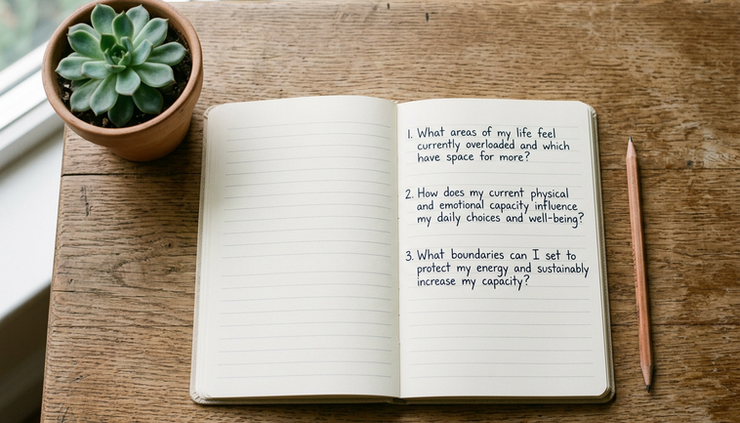
The load may be real, but so are your limits
Life will always include things that need carrying. Love asks us to carry. Responsibility asks us to carry. Growth asks us to carry. Faith, family, friendship, work, healing, and community all involve weight at times.
The question is whether the way you are carrying life is still sustainable.
If you feel overwhelmed, exhausted, distracted, numb, resentful, or emotionally unavailable, your capacity may be asking for attention. Not punishment. Not shame. Attention.
Start with the three questions:
What do I need to STOP carrying?
Think about the responsibilities, expectations, and emotional burdens you've taken on.
Are they all yours?
Are you solving problems that someone else is capable of solving?
Are you holding yourself to expectations that no longer fit your life?
What do I need SUPPORT carrying?
You don't have to do everything alone.
Where could you ask for help, delegate responsibilities, share the workload, or allow someone else to show up for you?
Being independent is a strength.
But knowing when to accept support is a strength, too.
What do I CHOOSE to continue carrying?
Not everything needs to go.
Some responsibilities are necessary.
Some relationships are meaningful.
Some commitments are worth the energy they require.
Let the answers be honest. Let them be imperfect. Let them change as your season changes.
Just because you can carry something does not mean you have the capacity to carry it at this moment. Wisdom is knowing the difference, and courage is making choices that protect the life you are trying to live.
The goal isn't to eliminate responsibility.
The goal is to become intentional about what you give your capacity to.
What About You?
I want to ask you something that we don't ask ourselves often enough.
When was the last time you did something for your internal self?
Not something productive.
Not something you checked off a to-do list.
Not something you did because somebody needed you.
Something you did simply because it fed your soul, brought you peace, helped you reconnect with yourself, or made you feel alive.
Maybe it was sitting quietly.
Taking a walk.
Listening to music.
Praying or meditating.
Laughing with friends.
Enjoying a hobby.
Taking a trip.
Or doing absolutely nothing without feeling guilty about it.
We spend so much of our lives pouring outward that sometimes we forget we need to pour inward, too.
And caring for yourself shouldn't always be the last thing on your list.
A Final Thought
Life will always come with responsibilities, expectations, challenges, and unexpected situations. We cannot control everything life brings our way. But we can become more aware of how we're responding to it.
We can recognize our limits.
We can question the expectations we've accepted.
We can make different choices.
And we can learn that being strong doesn't mean carrying everything.
So the next time you find yourself saying, "I'll figure it out," pause for a moment.
Ask yourself:
Do I actually have the capacity for this?
Is this mine to carry?
What will saying yes to this require me to say no to?
And most importantly:
Am I leaving enough of myself to actually enjoy the life I'm working so hard to maintain?
Remember:
Just because I can carry it doesn't mean I have the capacity to carry it right now.
And recognizing that isn't weakness.
It's awareness.
And awareness is where alignment begins.
Continue the Conversation
At Awaken with Toya, we believe personal growth begins with becoming aware of who you are, what you need, and whether the life you're living aligns with the life you truly want.
Through mindset and personal growth coaching, we create space for honest reflection, meaningful conversations, and intentional change.
You don't need fixing. You need to align.
Visit www.awakenwithtoya.com to learn more about coaching, personal growth journeys, and opportunities to connect.
Awaken with Toya | Mindset. Awareness. Alignment.


Comments